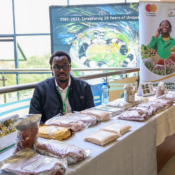

RE-GAIN program launched in Kenya, marking a new commercial era for grain markets
The RE-GAIN program, funded by the Green Climate Fund and Alliance for a Green Revolution in Africa (AGRA), and implemented by Africa Harvest and the Eastern Africa Grain Council EAGC, was officially launched in Tharaka Nithi and Embu counties on 17th and 19th February 2026.
The program introduces a major shift in how Kenya addresses food loss, treating it not only as a food security issue but as a high-potential commercial opportunity for farmers, technology providers, and financial institutions.
RE-GAIN’s primary objective in Kenya is to reduce post-harvest losses in the maize and beans value chains over the next three years. By promoting access to and adoption of Food Loss Reduction Solutions (FL-RS), the program aims to ensure that increased productivity translates into improved incomes and food security while reducing food waste.
“This program is timely,” said Dr. Florence Wambugu, CEO of Africa Harvest. “Post-harvest loss is like a silent thief. Farmers can lose up to 30% of their produce without even noticing.” She further noted that many agricultural initiatives have focused on production and good agronomic practices to boost yields, but fewer have deliberately addressed what happens after harvest.
A key highlight of the launch was understanding factors contributing to post-harvest loss and the clear positioning of FL-RS as a business solution. “Post-harvest equipment is usually very expensive for farmers to afford,” said Bonfrey Mugambi, a farmer and village-based advisor, during the RE-GAIN program launch in Tharaka Nithi County. “They often end up using traditional methods, such as beating maize with sticks, which leads to more wastage,” he explained.
EAGC Executive Director Gerald Masila reinforced this commercial message, noting that “when farmers work in groups and adopt Food Loss Reduction Solutions, they save more grain, cut transactional losses, and access higher-value markets, unlocking real business opportunities for farmers, service providers, and financiers alike.”
The program, therefore, builds not just technical capacity but a market ecosystem where private-sector actors benefit from increased demand, organized farmer markets, and predictable service-payment models.
County leaders echoed the economic importance of reducing food loss. Patrick Njue, Embu County Director for Agriculture, urged households to reduce waste at the consumption level, while Alex Muratha, County Secretary for Tharaka Nithi, noted that post-harvest loss not only reduces farmers’ income but also diminishes the effort invested throughout the production cycle.
Mercy Karimi, a farmer and village-based advisor from Embu, pointed out that many women farmers lose a significant portion of their maize after harvest due to a lack of knowledge and equipment. “RE-GAIN will particularly improve the livelihoods of women in Embu. They will finally earn income to take their children to school and meet other household needs,” she added.
The program partners and representatives from both county governments signed Memoranda of Understanding (MOUs) to strengthen their partnership and help guide RE-GAIN program implementation, ensuring coordinated support from county extension officers and sustained farmer mobilization. H.E. Hon. Justus Kinyua Mugo, Deputy Governor of Embu County, pledged county support and emphasized that food security remains a priority.
Over 143,000 farmers are expected to benefit from the program, comprising 20% youth and 50% women, through improved incomes, enhanced access to climate-smart technologies, and strengthened market linkages.
Beyond the numbers, the program signals a major market shift: loss reduction is becoming a profitable business opportunity, opening pathways for FL-RS companies to scale, and for banks, Savings and Credit Cooperative Organizations (SACCOs), and Microfinance Institutions (MFIs), to finance capital-intensive technologies through safer, group-based models.
The RE-GAIN program will redefine grain market competitiveness in Kenya, ensuring farmers save more grain, access better markets, and operate within a commercially-driven ecosystem. EAGC and Africa Harvest anticipate an era where every kilogram saved is income gained and where technology providers, financiers, and farmer groups all benefit from a more efficient, climate-smart grain system.